Apple announces new iPad Pro and Mac computers at its Brooklyn launch event

发布时间:2018-10-31 00:00
作者:Ameya360
来源:CNBC
阅读量:1587

Apple unveiled its latest iPad Pro models and Mac computers at an event in Brooklyn on Tuesday, offering long-awaited updates to some of its most popular devices.

The new iPad Pros eliminate the home button and incorporate Apple's facial recognition technology, Face ID, that was introduced with the company's iPhone X product line last year.

The tablets feature the same edge-to-edge LCD display that Apple introduced with the recently released iPhone XR, and they come with 11- and 12.9-inch displays. The Pro is thinner than ever and comes with sharper edges.

The iPads run on A12X bionic chips, a notch more powerful than Apple's high-end iPhone XS and XS Max smartphones. They ship with up to 1 terabyte of storage, and trade out Apple's typical Lightning port for a USB-C port, similar to high-end computers. The USB-C port will also let users connect accessories like digital cameras and high-resolution desktop displays to the iPad Pro. It does not have a traditional headphone jack, which means you will need an adapter to plug in your headphones.

The new iPad Pro starts at $799 for the 11-inch model and $999 for the 12.9-inch model. Both models are available to order Tuesday and will arrive on Nov. 7.

Apple updated its high-tech stylus, the Apple Pencil, as well. It now magnetically attaches to the tablet to charge wirelessly. It also has touch gestures for switching between digital drawing tools on the iPad.

MacBook Air

The new MacBook Air comes with a 13.3-inch, edge-to-edge retina display, as well as Touch ID that allows users to unlock the device with the scan of a fingerprint. The sensor sits in the keyboard and enables touch-based Apple Pay.

Apple revamped the keyboard and track pad, too, and upgraded the microphones and speakers for better audio. The new MacBook Air offers up to 16GB of storage — double the memory capacity of its predecessor.

Apple said it has made the computer lighter and reduced its overall volume by 17 percent. Every new MacBook Air is made entirely from recycled aluminum, the company said.

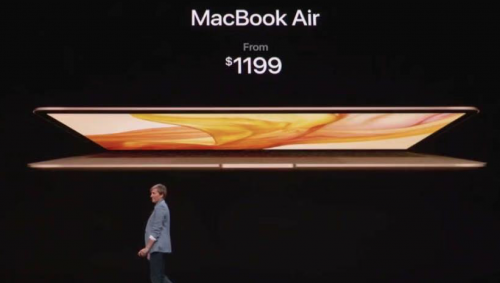
The new MacBook Air starts at $1,199, about $100 cheaper than the baseline MacBook computer, but more expensive than the last generation of MacBook Air, which started at $999. It's available to order Tuesday, and will be available for pickup Nov. 7.
Apple announces new iPad Pro and Mac computers at its Brooklyn launch event

Apple shows off new MacBook Air in Brooklyn.

Mac mini

Apple also introduced a new Mac mini Tuesday, in the first update to the smaller Mac model in four years.

The Mac mini is a desktop computer that connects to an external monitor. It comes with up to 64GB of memory and works five times faster than its predecessor, Apple said. Like the new Air, it's made entirely of recycled aluminum.

It starts at $799, and it too is available to order Tuesday. It will be available for pickup Nov. 7.

Finally on Tuesday, Apple announced its latest operating system, iOS 12.1 is available to install for iPhone and iPad users.

(备注:文章来源于网络,信息仅供参考,不代表本网站观点,如有侵权请联系删除!)

在线留言询价

相关阅读
Apple Reportedly Keeps 2nm 5G Modem Orders with TSMC Amid Intel Cooperation Signals
  While recent market chatter has focused on a potential shift by Apple between longtime foundry partner TSMC and Intel, the Economic Daily News, citing industry sources, reports that the Cupertino-based company remains heavily dependent on the Taiwanese foundry giant, as it plans to place its entire in-house 5G modem orders with TSMC, leveraging its 2nm process technology.  The report suggests that Apple’s self-developed 5G modem chips are expected to power future iPhone, iPad, and Apple Watch devices, replacing modems from Qualcomm. The volume used across its product lineup is projected to reach hundreds of millions of units, the report adds.  Notably, Apple’s iPhone 17 lineup is expected to be the last to ship with Qualcomm Incorporated’s 5G modems, as the company moves toward a full transition to its in-house C2 baseband chip across all iPhone 18 models, according to Wccftech.  The C2 development builds on Apple’s earlier in-house modem effort. Apple’s C1, first introduced in early 2025 with the iPhone 16e, marked its most complex chip system to date, integrating a 4nm baseband modem and a 7nm transceiver, according to earlier reporting from Reuters. The Economic Daily News further reports that Apple Inc.’s in-house C2 5G modem is expected to add full mmWave support—addressing the Sub-6 GHz limitation of its predecessor—while also incorporating satellite connectivity.  Supply chain sources cited in the Economic Daily News report say TSMC has already secured foundry orders for Apple’s modem chips. Its back-end testing partner is also reportedly preparing for higher demand, with around 600 test systems being procured, as capacity is set to ramp from 2027.  Apple’s Chip Tug-of-War: TSMC vs Intel  Though claims of an Apple order shift to Intel remain unconfirmed, and any such move would not signal a departure from TSMC, cooperation between Apple and Intel appears to be warming. According to The Wall Street Journal, the two companies have reportedly reached a preliminary agreement for Intel to manufacture some of the chips powering Apple devices.  The two sides have been engaged in intensive talks for more than a year, with a formal deal said to have been hammered out in recent months, the report adds.  In parallel, Commercial Times reported earlier that Apple is evaluating Intel’s 18A-P process for its M-series chips. Looking further ahead, The New 7 reports that the first Intel-manufactured low-end M-series chips could emerge as early as mid-2027 under contract production, likely targeting entry-level Macs or iPads.  As highlighted by The Wall Street Journal, Apple’s reported outreach to Intel may reflect growing supply chain pressures, as the Cupertino firm—long TSMC’s top customer—faces tightening access to advanced manufacturing capacity amid surging demand from NVIDIA and other AI chip designers.  Intel previously played a central role in powering Apple’s Mac lineup, before Apple transitioned in 2020 to its own Arm-based custom chips, the report points out.
2026-05-11 11:12 阅读量:441
Apple Reportedly Eyes Samsung, Intel U.S. Foundry for Core Chips Amid TSMC Constraints, Supply Diversification
  Apple is reportedly weighing the possibility of having some of its core device chips manufactured by Samsung and Intel. According to Bloomberg, citing sources, the company has held preliminary discussions on using the two as alternative production partners for its main processors—potentially providing a second sourcing option alongside its longstanding supplier, TSMC.  Sources say the company has held early-stage discussions with Intel about leveraging its foundry services, while Apple executives have also visited a Samsung facility under construction in Texas that is expected to produce advanced chips.  That said, the report notes that neither effort has led to any orders so far. Engagements with both suppliers remain at a preliminary stage, as Apple continues to have reservations about adopting non-TSMC manufacturing technologies.  One of the key drivers behind Apple’s potential shift is supply constraints at TSMC, according to Bloomberg. As the report notes, Apple executives addressed the issue during the company’s quarterly earnings call last week, indicating that limited chip availability for iPhone and Mac devices is currently weighing on growth.  In early 2026, Tim Cook identified access to advanced-node manufacturing as the main bottleneck for Apple’s iPhone output, according to CNBC. He noted that production is constrained by limited capacity for the company’s A-series and M-series system-on-chip (SoC) chips, which are fabricated on TSMC’s 3nm process.  In addition, it also aims to maintain at least two suppliers for key components, allowing Apple to strengthen its negotiating leverage on pricing while reducing the risk of supply disruptions, Bloomberg adds.  Apple’s Reported Supplier Talks May Open Door for Intel Comeback, Samsung Gains  Apple’s talks with both companies reportedly began before the most recent supply constraints emerged. As Bloomberg notes, collaborating with Intel could offer an added advantage, potentially strengthening Apple’s ties with the Donald Trump administration. As for Samsung, the report indicates that it has already been working on supplying more peripheral components for Apple’s devices, including power management parts.  In an August 2025 press release, Apple also announced a partnership with Samsung to co-develop a new chip manufacturing technology at Samsung’s Austin fab. Citing industry sources, Business Korea adds that the chip Samsung is expected to produce will likely be used as an image sensor in future iPhones and other Apple products.  Separately, industry momentum appears to be building around Intel’s foundry push. According to Commercial Times, major tech firms including Google and Apple are weighing a shift to Intel’s foundry. The report adds that Apple’s M-series chips are evaluating Intel’s 18A-P node.  Apple’s potential shift could provide a boost to both Samsung and Intel. As the report notes, securing external customers for its foundry business is central to Intel’s turnaround strategy under CEO Lip-Bu Tan. Winning Apple as a client would mark a major milestone for Tan and could help draw in additional business. Samsung, meanwhile, would also stand to gain significantly from an endorsement by Apple.
2026-05-06 14:44 阅读量:392
Apple Reveals Qualcomm Patent Fees
Qualcomm charges a 5% royalty, or about $12 to $20, per smartphone plus a large “CDMA tax,” Apple’s chief operating officer testified in an antitrust case here. The testimony put on the record some details of Qualcomm’s licensing practices that have long drawn industry complaints.Apple struck a deal with Qualcomm in 2007 to set royalties on iPhones at $7.50 per handset. In 2011, the two struck a deal to keep royalties at the same level while giving Qualcomm “short-term” exclusivity as the iPhone’s cellular baseband supplier.The “7.50 [royalty] may not sound like a lot, but it [amounted to] billions of dollars a year,” said Jeff Williams, who led the first iPhone team and is now Apple’s COO. “It is not FRAND, in our view, compared to everyone else … Qualcomm charged more than everyone else together.”“The alternative was that it defaults to the contract manufacturer’s rate of $17 to $18 [per phone, and] if we pursued them legally, we wouldn’t have access to chips … [and] risk getting our brand-new iPhone enjoined,” said Williams, adding, “Qualcomm represented [$7.50] as the average price paid.”Although patent licensing at the handset level has become widely used, Apple found it unfair.“We led the charge to add a lot of NAND memory” in handsets, but “if we put an extra $100 in NAND, they would get $5 of that even though they didn’t have anything to do with it,” he said. Apple spends “an extra $60 in stainless steel enclosures, and Qualcomm would collect an extra $3 — that didn’t make sense to us, and it still doesn’t today,” he added.The original $7.50 royalty “didn’t apply to CDMA phones or iPads,” said Williams, later calling licensing terms for the cellular protocol that Qualcomm developed “roughly a $250 million CDMA tax.”Apple initially proposed that it pay $1.50 per baseband chip used. Under the final deal, Apple’s contract manufacturers paid Qualcomm its usual 5% handset royalty under their existing patent licenses, Apple reimbursed them, and Qualcomm reimbursed Apple. Apple avoided striking a patent deal directly with Qualcomm under the arrangement.As part of the 2011 deal, Apple asked Qualcomm for a billion dollars to transition from using Infineon basebands.“They wanted exclusivity,” Williams said. “We proposed that we’d give them 100% sole-sourced for the short term, [but] in the long term, that wasn’t our plan.”However, “long-term [exclusivity] provisions wound up in the agreement … [and] made it prohibitively expensive to work with someone else,” he added. “For example, it cut off work with Intel” on a baseband for an iPad Mini in 2013 … overall, “our strategy is to dual-source.”Today, “Qualcomm continues to ship products on [Apple] design wins they have,” Williams said. “We have been unable to get them to support us on new design wins since [Apple sued Qualcomm in 2017]. This has been a challenge.”“Our strategy was to dual-source [basebands] in 2018,” he said. “We were working toward doing that with Qualcomm, but in the end, they would not support us and sell us chips.”As a result, “I went to [Intel CEO] Brian Krzanich and said that I was sorry, but instead of 50%, I need 100%” of iPhone basebands. “He had to scramble and go to his board to get almost a billion in capital to support us,” Williams said.Meanwhile, Qualcomm “is suing us in court all over the world on non-essential patents,” he said. “They are trying to get a hit in any one of those courts with an injunction to cause enough pain to make us pay tens of billions of dollars in their ransom … They said [that Apple is] an ideal target [because] unless [we] run the table, they will win.”In testimony Friday, Qualcomm’s CEO gave his own views on the deal and its efforts to continue working with Apple.Under cross-examination, a Qualcomm attorney noted that Apple gave the chip vendor a “moonshot challenge” to deliver a single chip baseband for LTE. The chip made it into the iPhone 5. In its launch, Apple founder Steve Jobs called the chip “one of the real breakthroughs” of the handset.
2019-01-15 00:00 阅读量:6105
Apple Testifies in Q’com Patent Case
Qualcomm and Apple faced off in San Jose District Court Friday in the ongoing dispute over patents. An Apple executive suggested Qualcomm’s royalties were more than $10 per iPhone.Qualcomm refused to supply chips without a patent license and paid Apple “huge” royalty rebates to use its cellular baseband chips exclusively, according to testimony today by Apple’s head of procurement in San Jose district court. Attorneys for Qualcomm noted Apple used Infineon and Intel modems exclusively at different periods and evaluated several alternative suppliers.The case, brought by the U.S. Federal Trade Commission, alleges Qualcomm has used unfair licensing policies to dominate the cellular chip market for years. Witnesses include a laundry list of carriers and chip and handset makers. The trial before Judge Lucy Koh is scheduled to conclude early next month.Tony Blevins, Apple’s vice president of procurement, recalled a "watershed meeting” in late 2013 with now Qualcomm president Cristiano Amon. At the time Apple was trying to reduce the cost of Qualcomm baseband chips it was using by conducting an analysis of manufacturing costs at TSMC where both companies both made chips.Amon “finally leveled with me. He said, ‘I just came back from an investors conference and I am under intense pressure to monitize [our technology] and I will have whatever the market can bear and Apple can afford to pay this — we don’t need to talk about costs and margins.’”Blevins said he canceled the rest of his meetings for the day. “We needed to do something different or we would be in a bad place, [so] we kicked off a new project to find an alternative supplier” called Project Antique, Blevins said.The effort ultimately led to exclusive use today of cellular modems from Intel’s wireless group, which has its heritage in the Infineon group that was the sole supplier for the first two generations of iPhones, a Qualcomm attorney noted.“We made this challenge, so Qualcomm was no longer willing to sell us chips…we want both Qualcomm and Intel in the mix — competition leads to…more diligent technical schedules and innovation,” Blevins said.Qualcomm’s alleged use of a unique practice of linking patent licensing deals to chip sales is at the heart of the case. Blevins said it first came to his attention in a 2005 letter from Qualcomm in response to Apple’s request for baseband samples and specs as part of an evaluation for the original iPhone.“In substitute of samples, we got this letter” asking for a patent license first. “In 20 years in this industry I had never seen a letter like this…Our interpretation was ‘no license, no chips,’” Blevins said.Qualcomm also asked for a cross-license to Apple’s IP.  “We were taken aback. We knew we would not cross license our IP back to them, we were [just] going to buy a chip,” he said.About two years ago, NXP asked Apple to sign a patent license in exchange for access to its NFC chips. “I was on vacation...and called [the NXP] CEO that day and said if they want more money put it in the hardware [price] and [we’ll see if] it's competitive. They withdrew their request for a license that day,” he said.Apple and Qualcomm struck five patent and supply agreements from 2007 to 2013. The latest ones included deals to get large rebates of royalties pad in exchange for exclusive use of Qualcomm modems.Qualcomm executives Derek Aberle and Amon both suggested Apple could get a “royalty less than $10 [per handset] only if we brought additional value to the table — if you bring me exclusivity,” Blevins said.Apple considered the reduced royalties to be still higher than those paid by its rivals, but they didn’t “gouge us…They made it very unattractive to choose another supplier…it was no longer a level playing field as it was before,” he added.Due to the exclusivity deal, Blevins cancelled plans in the works to use an Intel data-only cellular modem in an iPad Mini 2. Apple had internally agreed the design win would be a step to working Intel modems into iPhones.In a call to Hermann Eul, then Intel's general manager, “I expressed misgivings. They hadn’t don’t anything [wrong, but] we had an agreement with Qualcomm,” he said.In another meeting, the head of Qualcomm’s licensing group, Eric Reifschneider, asserted his dominance over Amon, who led the chip group, Blevins reported.“Cristiano was speaking directly to me, and Eric cut him off and said, ‘I run a division that makes two-thirds of corporate profits and you make one third, so let’s be clear who does the talking,’ I felt it was inappropriate in front of a customer to make such a statement and unfair to Cristiano,” Blevins said.Qualcomm would not agree to terms of supply agreements Apple considered standard with other suppliers, driving harder deals around patents, Belvins said. “It was uncommon for me to deal with any company’s licensing team, but with Qualcomm it became common,” he added.A Qualcomm attorney noted that in 2007-2009 agreements, Apple agreed to pay Qualcomm royalties although it did not buy its chips then. Apple continues to consider Mediatek and Samsung as alternative baseband suppliers and in the past had considered ST Ericsson and Texas Instruments as well, she noted.The FTC continued its case Friday with testimony from licensing and procurement executives from Samsung and Lenovo’s Motorola group.
2019-01-14 00:00 阅读量:1886
  • 一周热料
  • 紧缺物料秒杀
型号 品牌 询价
CDZVT2R20B ROHM Semiconductor
TL431ACLPR Texas Instruments
RB751G-40T2R ROHM Semiconductor
MC33074DR2G onsemi
BD71847AMWV-E2 ROHM Semiconductor
型号 品牌 抢购
ESR03EZPJ151 ROHM Semiconductor
TPS63050YFFR Texas Instruments
IPZ40N04S5L4R8ATMA1 Infineon Technologies
BP3621 ROHM Semiconductor
STM32F429IGT6 STMicroelectronics
BU33JA2MNVX-CTL ROHM Semiconductor
热门标签
ROHM
Aavid
Averlogic
开发板
SUSUMU
NXP
PCB
传感器
半导体
相关百科
关于我们
AMEYA360微信服务号 AMEYA360微信服务号
AMEYA360商城(www.ameya360.com)上线于2011年,现 有超过3500家优质供应商,收录600万种产品型号数据,100 多万种元器件库存可供选购,产品覆盖MCU+存储器+电源芯 片+IGBT+MOS管+运放+射频蓝牙+传感器+电阻电容电感+ 连接器等多个领域,平台主营业务涵盖电子元器件现货销售、 BOM配单及提供产品配套资料等,为广大客户提供一站式购 销服务。

请输入下方图片中的验证码:

验证码